
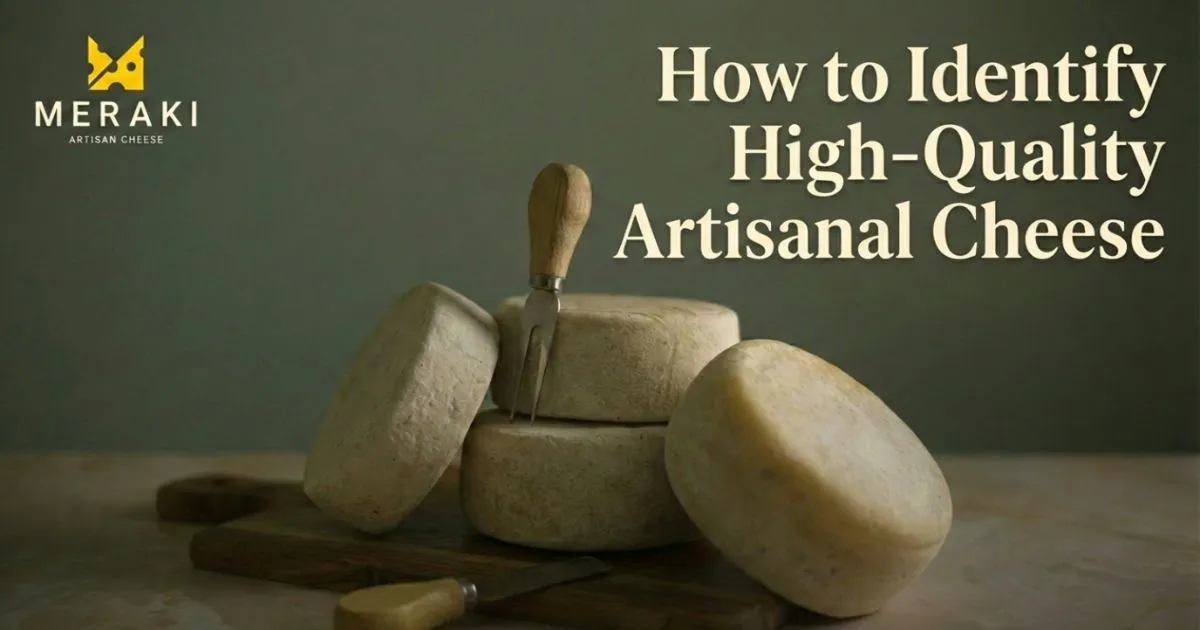
“If mass-produced cheese is a recorded song on repeat, artisanal cheese is a live performance, flawed, bold, unforgettable.”
High-quality artisanal cheese doesn’t announce itself with flashy labels or perfect symmetry. It whispers and asks you to slow down, pay attention, and trust your senses. Unlike mass-produced cheese, artisanal cheese carries human fingerprints in every wheel, wedge, and rind.
To identify a truly exceptional artisanal cheese, you don’t need to be a cheesemonger or memorise French terms. What you need is curiosity, awareness, and a willingness to look beyond the supermarket shine. This guide takes a different route, not by listing rules, but by teaching you how to read cheese like a story.
The Basics of Artisanal or Natural Cheese
Not every cheese carries the same level of care or craftsmanship. Artisanal or natural unprocessed cheese is the result of patience, place, and practised hands coming together. Unlike mass-produced varieties, it is crafted in small batches using minimal or zero machine intervention, allowing the natural character of the milk to lead the way.
Factors such as local climate, animal diet, and traditional techniques influence texture, aroma, and flavour, giving each cheese a distinct identity rather than uniformity. Free from synthetic additives and shortcuts, artisanal cheese is made slowly and is left to mature at its own pace, developing depth and complexity over time. Every wheel or wedge tells a quiet story of craftsmanship, where human skill works in harmony with nature to create something both nourishing and deeply expressive.
Identifying Artisanal Cheese: Key Aspects to Look For
1. Start with the Origin
Do you know that high-quality artisanal cheese begins long before the milk touches a vat? Its first clue lies in where it comes from. So, ask yourself:
- Does the cheese clearly state its place of origin?
- Is the region known for dairy farming, specific climates, or traditional cheesemaking?
Artisanal cheesemakers are proud of their geography. You’ll often see references to:
- Small towns or valleys
- Specific farms
- Pasture-based or seasonal milk
Cheese made from milk sourced within a limited area tends to reflect local grasses, weather, and animal diet. That sense of place, often called terroir, is impossible to fake at scale.
2. Read the Ingredients Like a Minimalist
Another very prominent way to identify authentic artisanal cheese is to examine the list of ingredients. High-quality artisanal cheese always keeps its ingredient list short and honest. Artisanal cheese generally contains:
- High-quality milk
- Starter culture
- Rennet
- Salt
Artisanal cheese relies on time and technique, not chemistry, to create flavour and texture. Every extra stabiliser, thickener, or “natural flavour” usually signals industrial shortcuts. Artisanal cheese doesn’t contain stabilizers, emulsifiers, or any artificial preservatives. The purity of all these ingredients results in a cheese with a superior texture and a natural or rich flavour.
3. Production Procedure: Handcrafted, Not Mass-Produced
The beauty of premium-quality artisanal cheese lies in its production procedure. Artisanal cheese is made using conventional techniques that prioritize craftsmanship over automation. Small-batch production enables cheesemakers to review and adjust the procedure to boost both flavour and texture. In contrast, industrial cheese always focuses on intensive machine-driven processing for uniformity and efficiency, often compromising the unique traits that make cheese special.
4. Texture Should Feel Alive, Not Engineered
Texture is another major indicator of artisanal cheese. Since artisanal cheeses are made with zero or minimal machine intervention, they develop unique textures ranging from spreadable and creamy to crumbly and firm. Uniform, smooth textures and shapes often signal usage of emulsifiers, industrial moulds, accelerated aging and large-scale packaging mechanisms. Cheese is a fermented food, and hence it should feel dynamic, not frozen in perfection. For this reason, touch always matters. When gently pressed:
- Soft cheeses should yield slightly, not collapse
- Semi-hard cheeses should feel elastic, not rubbery
- Hard cheeses may feel resistant and firm. It should not spring back much because of its dense texture.
Cut surfaces of an artisanal cheese reveal even more about its texture. High-quality artisanal cheese often shows:
- Small, irregular holes
- Slight moisture variation
- A paste that changes texture from rind to centre
5. Aroma Is More Honest Than Taste
An authentic artisanal cheese speaks first through the nose, long before it ever touches the tongue. Even before taking a bite, aroma offers the most reliable insight into a cheese’s quality. Smell reveals how the cheese was made, aged, and cared for, often more clearly than flavour alone. High-quality artisanal cheese typically carries natural, layered aromas such as:
- fresh grass
- toasted nuts
- forest mushrooms
- warm broth.
Some varieties may even have a gentle funk, but it should feel earthy and inviting, never harsh or chemical. While buying an artisanal cheese, always keep in mind the warning signs mentioned below.
- Sour milk smell
- Ammonia burn (especially overpowering in soft cheeses)
- Flat or “nothing” aroma
A high-quality artisanal cheese should always smell like something, since subtlety has a character too.
6. Flavour Should Evolve, Not Just Sit There
True artisanal cheese doesn’t rush to impress; it reveals itself slowly. Each bite unfolds new layers of flavour, shaped by quality milk, time-honoured aging methods, and naturally occurring cultures. These elements create taste profiles that range from nutty, earthy, and tangy to buttery, sharp, or gently sweet. First, take a small bite of cheese and let it warm on your tongue. High-quality artisanal cheese doesn’t deliver everything at once. Instead, it unfolds:
- A gentle beginning
- A developed middle
- A lingering finish
You might notice:
- Sweetness followed by salt
- Earthiness giving way to fruit or nuts
- A long aftertaste that stays interesting
Mass-produced cheese, by comparison, often relies on artificial enhancements, resulting in flavours that are predictable, muted, and uniform rather than expressive. Mass-produced cheese thus often tastes loud at first, then disappears quickly. Great cheese always lingers and tells a story after the bite is gone.
7. Let the Rind Tell You the Truth
Artisanal Cheese can be both fresh and aged. Another very significant aspect of identifying an aged artisanal cheese is natural rind formation. Artisanal cheeses undergo an aging procedure known as affinage. This procedure enables complicated flavours to develop over time. During this procedure, cheeses may develop natural rinds, slight variations in texture or mould patterns, all signs of a naturally aged, well-crafted cheese. The rind is the résumé of a cheese as it reveals how it was aged, cared for, and respected.
So, what to look for:
- Natural rinds that appear uneven, rustic, or slightly imperfect
- Bloomy rinds (like Brie or Camembert) that are white but not plastic-smooth
- Washed rinds with earthy aromas and sticky textures
High-quality artisanal rinds often show:
- Colour variation
- Light cracking
- Signs of hand-turning
- Regular brushing
While buying an artisanal cheese, always keep in mind that imperfection is not a flaw; it’s evidence of life. Hence, always avoid:
- Cracked, overly dry rinds with a hollow smell
- Artificial waxes on cheeses that are meant to breathe
- Rinds that look sprayed or unnaturally uniform
8. Seasonality Is a Hidden Marker of Quality
Many of us are unaware that exceptional artisanal cheese respects seasons. Milk from spring and early summer tends to produce:
- Brighter flavours
- Softer textures
- More aromatic profiles
Winter cheeses may be:
- Denser
- More savoury
- Subtly restrained
If a cheese tastes the same year-round, it’s likely engineered for consistency rather than expression. Always keep in mind that seasonal variation is a feature, not a flaw.
9. Aging Should Add Depth, Not Dryness
Aging is less about the calendar and more about craftsmanship. When artisanal cheese is aged with attention and skill, it develops deep, concentrated flavours without turning bitter. It retains the right balance of moisture, and well-aged cheeses may form delicate crystals that add a pleasant crunch rather than a chalky bite. Poor aging often results in:
- Overly dry interiors
- Harsh saltiness
- One-note sharpness
Asking about the aging process always matters. Cheeses matured in cellars, caves, or carefully managed natural environments typically achieve greater complexity than those rushed through industrial aging facilities.
10. Trust Your Curiosity Over Price Tags
Price alone is not a reliable indicator of quality in cheese. While some exceptional cheeses may come at a higher cost, many thoughtfully made artisanal varieties remain reasonably priced. Likewise, a lower price does not automatically signal poor craftsmanship or inferior ingredients. Rather than focusing on labels or perceived luxury, it is more meaningful to evaluate the cheese itself.
Instead of asking, “Is this fancy?” consider these questions:
- Does this cheese feel honest?
- Does it taste alive?
- Does it leave an impression?
Truly high-quality artisanal cheese stands out through character and balance. It naturally draws attention through flavour, texture, and authenticity without relying on excess branding or dramatic presentation.
The Maker’s Story Matters More Than Marketing
Artisanal cheese is defined by purpose and transparency, not mass appeal. Genuine craft begins with makers who are open about how their cheese is produced, where their milk comes from, and the scale at which they work. Small batches and limited runs often signal careful attention rather than industrial output. Hence, always look for:
- Cheesemakers who share their process openly
- Transparency about milk sourcing
- Clear production scale (small batches, limited runs)
Reputable producers focus their conversations on the fundamentals that shape quality rather than marketing language.
High-quality producers talk about:
- Animals
- Land
- Technique
- Time
When the narrative centres on thoughtful practices and long-term care instead of awards and exaggerated descriptors, it usually reflects a cheese made with integrity and genuine craftsmanship.
Final Thought: Great Cheese Is a Conversation
Recognizing exceptional artisanal cheese isn’t about following a checklist; it’s all about paying attention. It means observing how it feels, letting its aroma speak, embracing its natural irregularities, and appreciating the craftsmanship behind every wheel. Cheese made with quality milk, time, and thoughtful care quietly reveals its story to those who slow down and notice.
So, are you ready to experience that difference for yourself? Explore a thoughtfully curated gourmet cheese gift online from Meraki Cheese and discover how true artisanal quality transforms the way you enjoy and share cheese.
Fun Fact: No two wheels of true artisanal cheese are ever identical. Even when they’re made on the same day, from the same milk, by the same cheesemaker.